Hazardous tree removal: when an assessment finds real risk indicators

This is for a tree where a professional look has already turned up something specific — a crack, a worsening lean, decay evidence, a dead major limb, a weak union — and the question now is what removing it for that reason actually involves. If a tree is failing right now, see emergency tree removal instead.

Describe what the assessment found
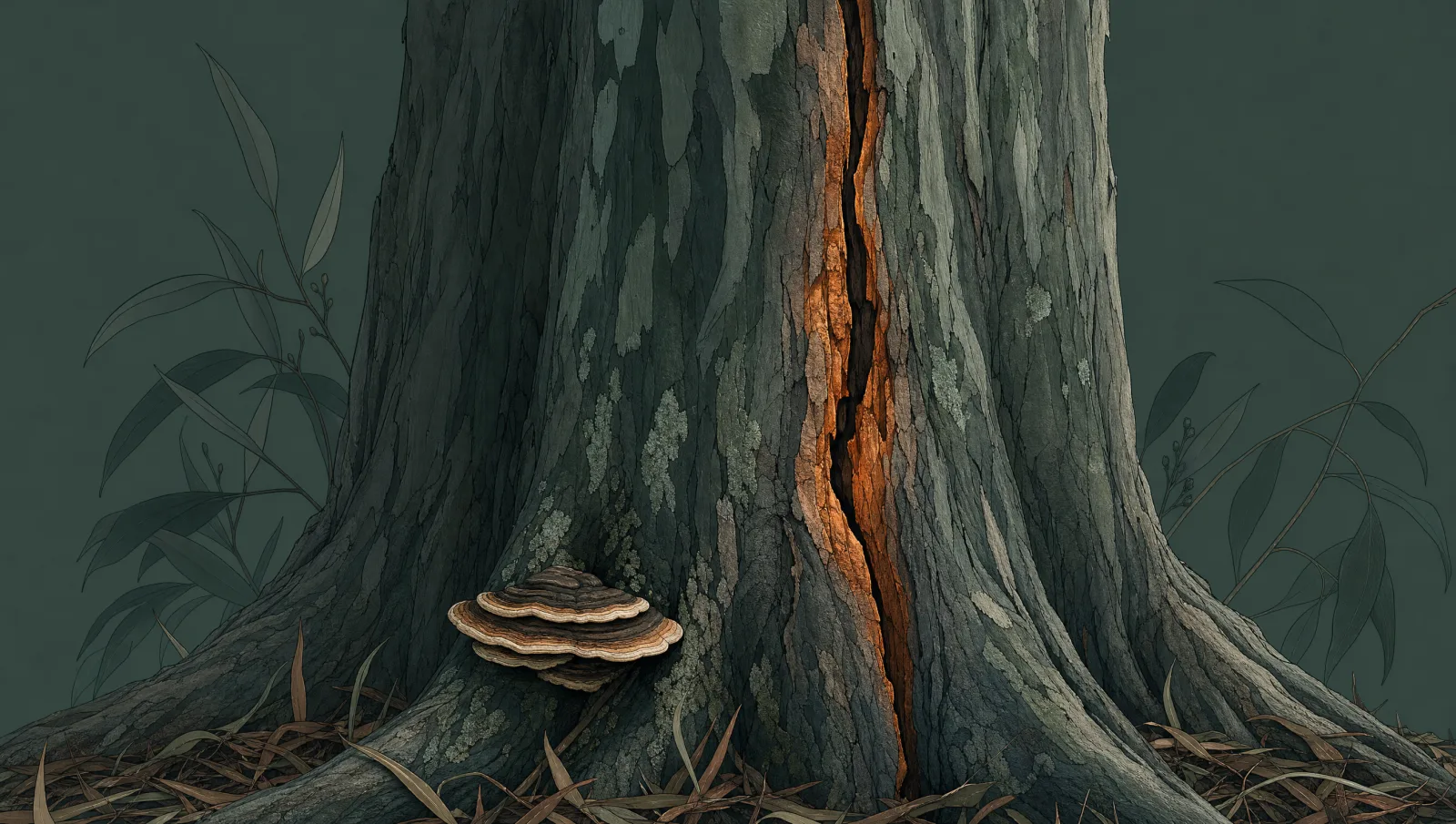
Close illustration of a tree trunk showing a visible vertical structural crack near the base.

What "documented risk indicators" actually means

  • A visible crack in the trunk or a major limbA crack running into the wood — as opposed to bark that is simply rough or peeling — signals a structural weak point. Whether it warrants removal depends on its length, depth, and where it sits on the tree, which is exactly what an assessment is for.
  • A lean that has increased, or that came with visible root-plate disturbanceMany trees have always had some lean and are stable that way. What changes the picture is a lean that has gotten worse, or one paired with lifted or cracked soil at the base, which can indicate the root system is losing its grip.
  • Fungal fruiting bodies (conks, mushrooms) at the base or on the trunkThese are often a visible sign of internal decay, even when the tree still looks green and healthy in the canopy. Their presence is a real reason to have the tree looked at, not an automatic removal verdict on its own.
  • A dead major limb or a large section of dead canopyA dead limb of meaningful size loses strength over time and can fail without warning. Whether the fix is removing that limb or removing the whole tree depends on how much of the tree is affected and what caused it.
  • An arborist assessment or inspection report already flagged the treeIf someone has already put a name to what is wrong with the tree, this page covers what happens between that finding and getting the removal itself scheduled.

"Looks concerning" and "confirmed hazardous" are different things

  1. Distinguish a cosmetic issue from a structural oneBark that looks rough, a canopy that is thinner than a neighbor, or a slight natural lean are common and often not hazard indicators at all. A hazard assessment is specifically looking for structural defects, not general untidiness.
  2. Evaluate what the specific indicator actually means for that treeThe same finding can carry different weight depending on species, tree size, and location — a crack on a small ornamental tree away from anything it could hit is a different situation than the same crack on a large tree over a driveway or a structure.
  3. Weigh what the tree could hit if it failedA documented defect on a tree with nothing nearby is a different decision than the same defect over a house, a fence line, or a spot where people regularly park or walk. Target proximity is part of what makes a hazard finding actionable.
  4. Decide between removal and a lesser interventionNot every documented indicator ends in removal — a cabled limb, reduced canopy weight, or monitoring over time can sometimes address the specific risk found. Removal is the answer when the defect is severe enough, or central enough to the tree's structure, that no lesser step reliably addresses it.

How a hazard finding changes the removal itself

Standard removal, hazard-informed sequencing

Fits when: The documented defect (a crack, a dead limb, decay in a specific section) affects a known, identifiable part of the tree, and the surrounding site is open.

Trade-off: The removal sequence is planned around where the weak point is, which can mean starting the cut differently than a routine removal would — this takes more assessment time up front but is not necessarily more expensive overall.

Sectional (rigged) removal

Fits when: The defect is significant enough, or the tree large enough, that an uncontrolled drop of any section is not acceptable — especially with a structure, fence, or property line nearby.

Trade-off: More labor-intensive and generally more expensive than a direct fell, because a structurally compromised tree gives less margin for error during the cut sequence.

Crane-assisted removal

Fits when: A large tree with a severe structural defect where rigging alone cannot reliably control piece size and direction, particularly with limited access or high-value targets nearby.

Trade-off: The most equipment-intensive and typically most expensive method, but sometimes the only way to remove a genuinely compromised tree without unacceptable risk during the work itself.
Access, safety, and what to do in the meantime

Keep clear of the affected area

Until a professional has assessed the tree and a removal is scheduled, it is reasonable to limit time spent, parking, or storage directly under or near a tree with a documented structural defect.

Utility line proximity

A hazardous tree with limbs in or near power lines typically needs utility company coordination before any work near the line proceeds, independent of the removal itself.

Site access for the removal method

Gate widths, slope, and how close equipment can get to the tree affect whether a direct fell, rigged, or crane-assisted approach is realistic — this gets confirmed during the assessment, not guessed at beforehand.

Permits

Some San Diego County cities require a permit for removing a tree above a certain size or a protected species, and a documented hazard finding is often part of what supports that permit application — see our permits and protected-tree guide.

If the situation changes and becomes an active emergency

A documented defect that suddenly worsens — a new crack widening, visible new lean, or the tree beginning to move — is a different situation than a considered removal decision. If that happens, keep people and vehicles clear and contact local emergency services or the utility company if lines are involved; see emergency tree removal for that scenario.

What affects the cost of a hazard-based removal

Severity and location of the documented defect

A defect near the base affecting the whole tree's stability requires more careful sequencing than one confined to a single upper limb.

Tree size and species

Larger trees and denser wood take longer to remove and produce more material to process, same as any removal.

Access and site constraints

Tight gates, slope, or a compromised tree near structures push toward sectional or crane-assisted methods, which cost more than a direct fell.

What the tree could hit if the removal plan has to change

Structures, lines, and property lines near a structurally weak tree add planning time and often require more controlled — and more expensive — removal methods.

Whether stump removal is included

Removal and stump grinding are typically priced as separate steps — see our stump grinding vs. stump removal guide.

Permit requirements

Where a permit applies, the time involved in that process is part of the overall project timeline and sometimes the cost.

From documented finding to completed removal

  1. Assessment and confirmationA site visit confirms the specific indicator, evaluates its severity, and determines whether removal or a lesser step is the appropriate response.
  2. Removal plan and quoteThe removal method (direct, sectional, or crane-assisted) is chosen based on the defect's severity, the tree's size, and what is nearby.
  3. Permit check, if applicableCan add time to the overall timeline if the tree is protected or the city requires a removal permit — worth checking early.
  4. Clear the work areaMoving vehicles, furniture, and anything valuable out of the drop zone and equipment path ahead of the scheduled date.
  5. The removal itselfDuration depends on size, defect severity, and method — a straightforward case can take a few hours; a large, structurally compromised tree in tight access can take a full day or more.
  6. Cleanup and disposalWood and debris removal is typically part of the quoted job; confirm what is included versus billed separately.

What is specific to hazard findings in San Diego County

The county's mix of coastal, canyon, and inland conditions produces different hazard patterns — root disturbance is more common on slopes and canyon-adjacent lots where soil movement is a factor, while heat and drought stress in inland areas can accelerate decay in already-weakened trees. Wind exposure varies block to block near the coast and in canyon corridors, which affects how much weight a documented defect can safely carry before it becomes a removal candidate. None of that changes the fact that an actual assessment of the specific tree, not a general rule about the area, is what determines whether removal is warranted.

Where we help with hazardous tree removal

Across San Diego County, including these areas with their own local considerations.

    Questions people ask

    Does a crack or lean automatically mean a tree has to come down?

    No. A documented indicator is a reason to have the tree assessed, not an automatic removal verdict — severity, location on the tree, species, and what the tree could hit if it failed all factor into whether removal or a lesser step is appropriate.

    How is this different from an emergency removal?

    This page covers a tree where a defect has been identified through assessment and there is time to plan the removal properly. If a tree is actively failing, has already partially fallen, or is visibly moving right now, that is an active emergency — see emergency tree removal and keep the area clear in the meantime.

    What if the indicator was found after a storm?

    If the defect is directly tied to recent storm damage — broken limbs, wind-caused lean, visible storm impact — see storm damage tree service, which covers that specific situation. This page is for a defect identified during a general assessment, independent of a specific storm event.

    Can I just have the affected limb removed instead of the whole tree?

    Sometimes. If the defect is confined to a specific limb and the rest of the tree is structurally sound, limb removal or pruning can be the right call. Whether that is enough versus needing to remove the whole tree depends on what the assessment finds — that is a decision made on the specific tree, not a general rule.

    Is hazardous tree removal guaranteed to be scheduled quickly?

    No — availability depends on the independent provider you are connected with, and this site does not guarantee response times or acceptance of any project. See the contractor matching disclosure for what submitting the form does and does not promise.

    Tell us what the assessment found

    Describe the specific indicator — crack, lean, decay, dead limb, or something else — roughly where the tree sits on the property, and whether a written assessment already exists.

    Request Service