Emergency Tree Removal
A tree or large limb has already failed or is actively failing — what to do right now and what happens next.
San Diego County tree-risk assessment and removal guidance — know what you are looking at before anyone brings out a chainsaw.
TreeRisk ExpertsA recent storm left a tree split, leaning, missing limbs, or with roots pushed up out of the ground — and now the question is what that damage actually means and what should happen next. Describe what you are seeing and we will help you get that answer.
Describe the damage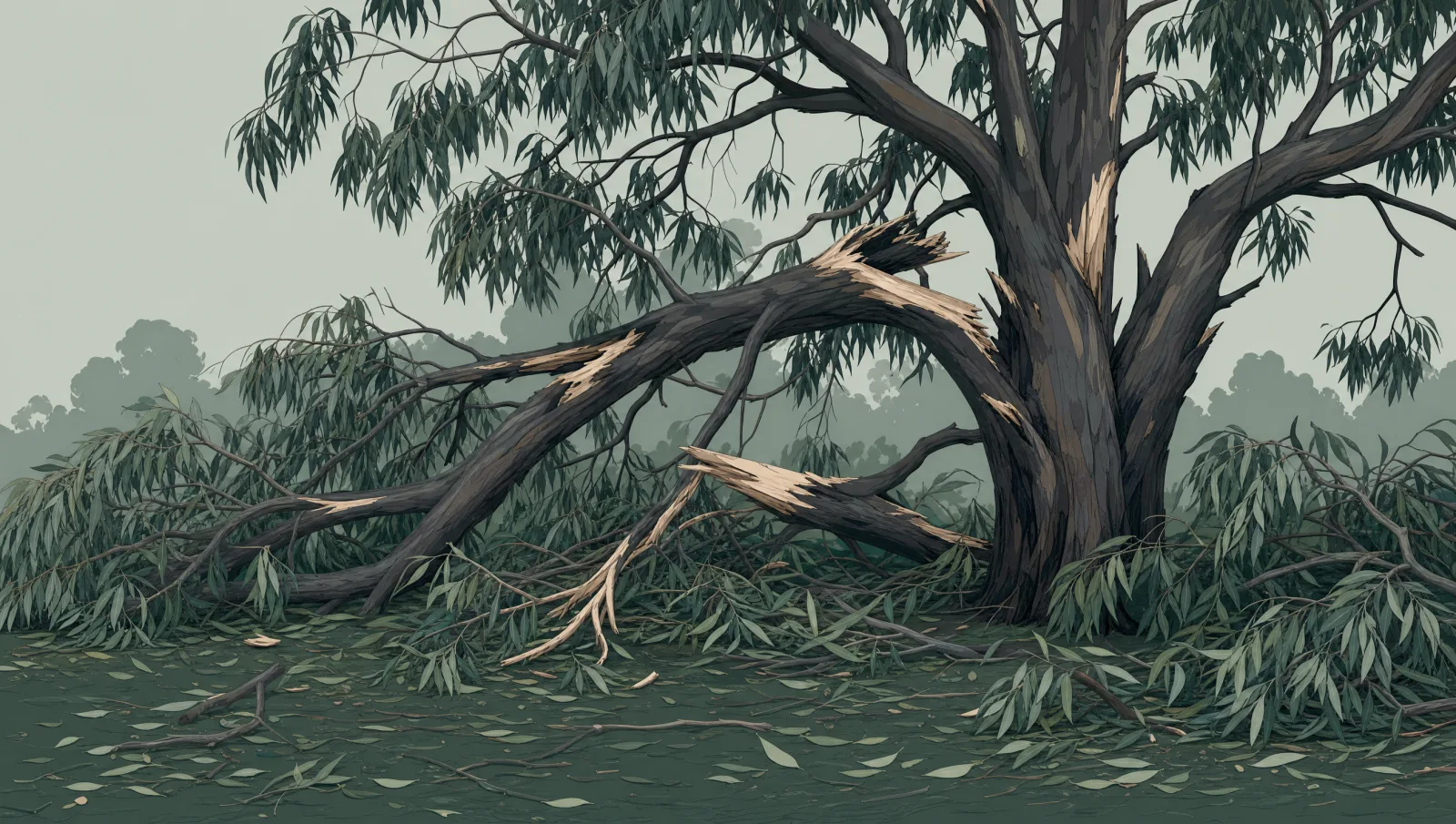
A damaged tree or limb in or near a power line requires utility coordination before any work near the line can proceed, independent of the tree work itself.
A leaning tree or a hung-up limb caught in another tree changes the order of operations and the equipment needed, since the priority becomes controlling where it goes rather than a straightforward cut.
Storm debris, downed limbs from neighboring trees, or soft ground from heavy rain can all limit how equipment reaches the tree, which is assessed on site rather than assumed in advance.
A storm that damages one tree on a property has often affected others nearby. Where that is the case, it is usually worth having the whole property looked at in one visit rather than one tree at a time.
Removing a damaged limb is generally far less involved than removing the whole tree, and bracing a salvageable tree is its own separate scope from either — the assessment determines which applies.
A storm that brought down large limbs or an entire tree usually means more material to process and haul, which is often a meaningful part of the total.
Soft or saturated ground, downed debris blocking normal access, or damage on a slope can all slow the work and change what equipment can safely be used.
Damage near anything the tree or its remaining parts could still land on generally requires more controlled, and more time-consuming, methods.
Addressing several storm-damaged trees in one visit is typically more efficient than separate calls for each, which can affect the overall price.
San Diego County does not see storms as frequently as many regions, which cuts both ways: trees here are less conditioned to high wind loads, so a single strong Santa Ana wind event or an unusually heavy rain system can cause damage that would be routine for trees in a windier climate. Saturated soil after a heavy-rain stretch is also a factor worth knowing about — a tree that survived the wind can still develop a lean in the days after, once the ground around its roots has softened. Canyon-adjacent and coastal-exposed properties tend to see the most wind-related limb and lean damage in the county.
Across San Diego County, including these areas with their own local considerations.
Usually not. Small broken twigs and stripped leaves are typically cosmetic, and most trees recover from that kind of damage on their own or with minor cleanup pruning. It is worth a closer look if the tree also shows a new lean, a cracked major limb, or disturbed soil near the base — those point to something more structural.
Not always, but a new or worsened lean after a storm is one of the signs worth taking seriously, since it can indicate root damage that is not visible above ground. If the tree is actively failing or has already come down onto something, that is an active-hazard situation — see our emergency tree removal page. If it is leaning but stable, it still typically warrants an assessment sooner rather than later.
We would not recommend it. A cracked or hanging limb can be under tension in ways that are not obvious from the ground, and working near storm-damaged wood carries real risk. Keep people and pets clear and have it assessed rather than attempting the cut yourself.
Keep everyone away from it and treat it as a utility and safety matter first — contact the utility company or emergency services rather than a tree-service provider. Tree work near an energized line should only happen after the utility company has been involved.
This page covers damage tied to a specific storm event — a split limb, a new lean, exposed roots, a broken top. A tree that is simply dead, unwanted, or in the way of other work without any storm involved is covered on our tree removal page instead; the assessment approach overlaps but the starting question is different.
No — availability depends on the independent provider you are connected with, and this site does not guarantee response times or acceptance of any project. See the contractor matching disclosure for what submitting the form does and does not promise.
What happened — a split limb, a new lean, a broken top, exposed roots — and roughly where the tree sits on the property.
Request ServicePrefer to call? (619) 853-5977